blog tour · fantasy · fiction · YA

The WriteReads Presents: Magic Unleashed (Venators #1) by Devri Walls Blog Tour!

Welcome to the latest stop on The WriteReads’ Super Awesome Blog Tour for Magic Unleashed (Venators #1) by Devri Walls (Brown Books, 2018, first published 2016). I’m happy to be a part of this! Urban fantasy isn’t my usual genre, but I’m always willing to challenge myself and read outside my normal box, and this was definitely outside- but in a good way.

Rune and Ryker are twins, but they’ve grown apart over the years, and Rune is bothered by this. She’s still there for her brother, who takes far too much delight in bullying Grey, the trenchcoat-wearing misfit from their hometown who ended up at the same college as them, but she’s none too happy with his recent behavior. Beyond that, Ryker has bizarre reactions to the supernatural just as Rune does- rage, mostly, and she can’t understand why.

Grey’s obsessed with everything supernatural and has been ever since that terrifying night years ago when he was attacked by creatures he’d never seen before. When they reappear in his life, just as Rune is starting to realize the two of them may have more of a connection than she previously expected, the two of them are whisked away to the safety- relatively speaking- of another dimension, where they learn the truth about their existence. Everything supernatural, every mythical creature and thing that goes bump in the night, is real, and Grey, Rune, and Ryker, who was kidnapped and taken elsewhere, are Venators, some of the last of their kind, a group once tasked with protection but overtaken by their own rage to the point of devastation of the world around them. The council demands their help, but there are serious games afoot, and Grey and Rune can never be sure who they can trust. Fairies, vampires, werewolves, goblins, shapeshifters, they’re all out there and they all have their own agendas. And where is Ryker???

ACTION. MAJOR ACTION EVERYWHERE. This isn’t one of those fantasy novels where the characters spend 90% of the book trudging through the woods (*stares in Tolkien*). Magic Unleashed (Venators #1) is high-stakes action and the pressure is ON. Grey (who is a fabulous character, an ugly ducking who becomes a swan and stands up for what’s right, even when it puts his own life at risk) and Rune are in the middle of it on every single page, fighting, running, jumping off cliffs (thanks to their newly discovered Venator powers!), sneaking through musty-smelling servant passageways to escape the castle in the dark of night. Ryker’s a full-on douchebag, but the novel isn’t focused on him; let’s hope he improves as the series progresses. I’m wildly curious to know his reaction when the camera pans to him in the next book!

I enjoyed the cast of magical characters: the terrifying, bloodthirsty werewolves, the manipulative fairies, the slick vampires, but my favorite character was Beltran, the shapeshifter who often appears in the form of a crow. He’s definitely got his own agenda, but there’s more to him than meets the eye, and I enjoyed every scene he appeared in. His appearance totally made the last major action scene.

Whenever I step outside my normal genres, I like to examine why I don’t read that particular genre more often, and I did come to some conclusions I hadn’t considered before while reading this- interestingly enough, it’s related to something my husband and I have been discussing recently. My husband is a very visual thinker; he’s a scientist and can usually picture exactly how any experiments he runs will work, because he can picture the mechanisms by which everything should function. This serves him well in computer programming as well. I can’t think in pictures like this. Even when I think something random like, “Okay, I’m going to picture a cereal box on the counter,” I can kiiiiiiiiiiiiiiiiiind of make a sort of mental picture, but I can’t hold it. I can kind of picture what my counter would look like if there were a cereal box on it, but only a brief glimpse. It’s fascinating how our brains work in completely opposite ways.

That said, I think that’s why I don’t read more fantasy (and it’s a genre my husband likes!): I can’t quite picture these magical creatures in my head, nor can I picture the settings that involve castles and labyrinthine mountain passes and forests. They’re not places I’ve been or creatures I’ve seen. With fiction, I can mentally set those stories in houses, in restaurants, in museums and shops and parks that are familiar to me and that I have a map of in my head. I can assign the characters physical traits of people I’m familiar with. Fantasy? Not quite so much; I can’t picture a green-skinned person in my mind because it’s not an image I’m familiar with in my everyday, boring life.

Isn’t that wild? I’ve never thought of it that way before, but I think I’ve got the answer as to why this isn’t one of my preferred genres, even though I LOVE seeing how excited other readers get over it! So it really does pay to step outside your boundaries now and then. You might learn something new about yourself. 🙂

If you’re into fantasy that doesn’t skimp on the action one single iota, Magic Unleashed (Venators #1) is worth a look- it’s a series, people! Devri Walls seems to be a wildly prolific author, so check out some of her other work as well on Goodreads.

I’m told that Ms. Walls will be answering questions in a video post after the tour, so if you’ve got questions, ask away in the comments! (Seriously, how cool is she for doing this???) I have a question! Ms. Walls, are you able to think in pictures and easily imagine all the fantastic supernatural creatures you write about, or does your brain work in a different way?

Thanks to TheWriteReads and Devri Walls for including me on this fabulous blog tour!!!

Visit Devri Walls’s website here.

Follow her on Twitter here.

nonfiction · true crime

I’ll Be Gone in the Dark: One Woman’s Obsessive Search for the Golden State Killer- Michelle McNamara

So, according to Goodreads, I’m the last person on Earth to read I’ll Be Gone in the Dark: One Woman’s Obsessive Search for the Golden State Killer by Michelle McNamara (Harper, 2018). I read maybe a handful of true crime books every year; it’s not usually a section I wander through at the library, but if a case interests me for a particular reason or someone I know recommends something from this genre, I’ll pick it up. A ton of my friends read this last year; I finally picked it up based on a prompt for the 2020 PopSugar Reading Challenge: a book with gold, silver, or bronze in the title (this being an Olympic year and all…if the Olympics still happen, what with mass events like that getting cancelled due to coronavirus). Not being a huge true crime person, I went into this book almost entirely cold, which made for an interesting read.

Michelle McNamara was the wife of comedian Patton Oswalt. She passed away unexpectedly in her sleep from an accidental overdose in 2016, but in life she was a true crime writer and obsessively searched for the man she dubbed The Golden State Killer, a man who terrorized Southern California throughout the seventies and eighties. He was responsible for at least thirteen murders and more than fifty rapes (and who knows what other crimes haven’t been tied to him). Despite massive effort to pin him down, he always seemed able to slip through the fingers of law enforcement, to blend into the background and remain unnoticed.

Finding him was Michelle’s obsession. She dug through old evidence, interviewed witnesses, befriended investigators. From what it sounded like, she was as much a part of the investigation team as some of the officers and retired officers still at work on the case. She passed away before her book was finished, a heartbreaking ending to her story, and a devastating blow to her family.

SPOILER ALERT- not for the book, but for what came after:

I *thought* I remembered hearing things about this on the news recently, but I didn’t look it up while I was reading (and I wasn’t entirely sure if what I saw related to the case itself or to the book). It was only this morning, after I finished the book, that I allowed myself to Google, and sure enough, they found him, just as Michelle had so desperately hoped. His time had indeed run out, thanks to a DNA match that investigators were finally able to run through an ancestry site. With the help of a genealogist, suspects were narrowed down and a match was secured. The suspect, Joseph James DeAngelo, will go on trial at some point for being the Golden State Killer. Science is amazing, you guys. Back when he was terrorizing the people of Southern California, he was nearly unstoppable, but science hunted him down. I’ve seen articles purporting that the age of the serial killer is over, or at least greatly slowed down thanks to DNA testing, and I pray that’s the case.

Two major emotions settled in as I read Ms. McNamara’s work. First off, fear. It’s nigh impossible to read real-life accounts of home invasion, rape, murder, and the type of terror that this man evoked and not feel at least somewhat vulnerable. Even in this age of heavy locks, security systems, doorbell cameras, and the like, do any of us ever feel entirely safe? This book definitely creeped me out (and made me thankful for my cats, who would never greet me at the door like they did this morning if there were a stranger in the house, as they’re kind of terrified of strangers and scurry off to hide under the bed if someone they’re not familiar with enters the house) and made me a little more aware of my surroundings and my safety during the time I was reading.

And second, sadness. It’s hard to read the master work of someone who passed away so young, not only before she had a chance to finish the book but before she had a chance to see the case come to fruition the way it has. Reading the scenes where she talked about her husband and young daughter were heartbreaking, because I read them with the obvious knowledge that they’re still here and she’s not. Life is so very, very unfair in so many different ways. I wish Ms. McNamara were here to see this monster finally caught and celebrate his capture with her investigator friends. I wish she were here to watch her daughter grow up and to live out her natural life with her husband. I wish she could have finished the book with its rightful conclusion.

If you’re into true crime, you’ve probably already read this, but if you’re like me and only read the genre now and then, it’s a worthy pick despite the aura of sadness surrounding the untimely demise of its author. Lots of information on investigations and police procedures, what happens when a case goes cold, and the history and growth of DNA testing in here, and that alone makes it a great read, as does Ms. McNamara’s own history and her explanation of her involvement with the case.

Now that the suspect is caught, my thoughts go not only to his victims, but his family members. His ex-wife, his children, his grandchildren. They never asked for this, they never asked for the publicity or to be related to this monster. My heart breaks for the family members because he turned them into victims as well. I so hope they’re getting support from their friends and community, because this has nothing to do with them as people.

I’ll Be Gone in the Dark: One Woman’s Obsessive Search for the Golden State Killer is probably the most in-depth true crime study I’ve ever read, and I’ll definitely be following the trial much more closely than if I hadn’t read this.

Michelle McNamara passed away in 2016.

Monthly roundup

Monthly roundup: February 2020

Welcome to March! Winter and spring have been playing a bit of tug-of-war in these parts, with snow and icy winds on some days (although the monster snowstorm that had everyone freaking out ended up being a bust of about three inches total) and 50 degrees and rain on other days. I’ve been combating the cold by huddling under my heated blanket with my books on days I don’t have to be out of the house. It’s been nice!

That’s not to say I’ve had as much reading time as I would like- do we ever? Laundry and cooking and errands all still need to be done, kids need to be driven and picked up. I have a bunch of reading, both in the books we have for class and online articles, that I have to do for my class every week, so that takes up most of my Monday reading time. It’s been a busy but all-around pleasant month, I’d say.

Let’s round up some books, shall we?

What I Read in February 2020

  1. In Order to Live: A North Korean Girl’s Journey to Freedom by Yeonmi Park with Maryanne Vollers

2. The Blessings of a Skinned Knee: Using Jewish Teachings to Raise Self-Reliant Children by Wendy Mogel

3. The Three Escapes of Hannah Arendt: A Tyranny of Truth by Ken Krimstein

4. People of the Book by Geraldine Brooks

5. The Best of Sholom Aleichem by Sholom Aleichem, edited by Irving Howe and Ruth R. Wisse

6. As A Driven Leaf by Milton Steinberg

7. Hereville: How Mirka Got Her Sword by Barry Deutsch

8. Let’s Call It A Doomsday by Katie Henry

9. Aleph Isn’t Tough: An Introduction to Hebrew for Adults by Linda Motzkin and Hara Person (this and several other books are included in my post with four mini reviews, found here)

10. Not In God’s Name: Confronting Religious Violence by Rabbi Jonathan Sacks (no review)

11. How to Disappear by Sharon Huss Roat

12. The Worst Hard Time: The Untold Story of Those Who Survived the Great American Dust Bowl by Timothy Egan

13. Basic Judaism by Milton Steinberg (no review)

14. Love in the Time of Cholera by Gabriel García Márquez (no review, read as part of my own personal Read Harder Challenge)

15. Magic Unleashed (Venators #1) by Devri Walls (review to come, read as part of a blog tour)

Not a bad month, although I do miss the days where I was reading 20+ books a month! Some of the things I’ve been reading lately have taken more mental space, though, so I’ve been reading them more slowly and pausing to look up things I don’t understand or further delve into concepts that intrigue me. Basic Judaism by Milton Steinberg, for example, was only 170-some pages and a small-sized book at that, but he’s such an intelligent author that I had to reread things, look things up, pause to write down full paragraphs of things I wanted to remember, etc. Fiction of that length, I could normally blow through in a day, but this book took me several days. Six books ticked off of various reading challenges; it was a much slower month for that.

Reading Challenge Updates

Major slowdown this month! S’alright though, I’m not in a big hurry this year. I’ve been overwhelmed a little with class reading and the stack of library books I brought home last month (I still have three left!!!) and my outside reading for class, plus a book I need to read for an author talk coming up and another one I need to read for a blog tour, plus next month’s book club pick. Throw me a raft, I’m drowning here, people!!!

Here’s what my challenges look like right now.

(I only have books read for THIS page, so I won’t post the blank second page…)

Slowly but surely!

State of the Goodreads TBR

OY. 109 books, people. I’M DROWNING HERE. I’m dreaming of a deserted island, just me, a source of water, food, and shelter, and my TBR. No responsibilities, nothing to do, muscle atrophy no longer exists so I never have to get up and move around again, just endless time to read. Can you believe my TBR was at a cool 81 books a few months ago? *lolsob*

Books I Acquired in February 2020

NONE, thankfully! 😀

Bookish Things I Did in February 2020

It was a good month for bookish things! I heard author Andrew Solomon speak about mental health midmonth; if you’ve never read him before, Far From the Tree: Parents, Children, and the Search for Identity is incredible (he has others that I really want to read as well). And our monthly library book discussion group discussed In Order to Live by Yeonmi Park. It was a lively discussion and we were all pretty horrified by the living situations there. I came to the group having read several other books on North Korea, whereas this was the first for most members.

I also attended a lecture by Dr. Ross Greene, psychologist and author of books like The Explosive Child. He had a lot of really poignant things to say about kids with challenging behaviors, so at some point, I’m going to read his books for further information.

Current Podcast Love

Still listening to Unorthodox (and loving it!) and probably will be for a few months more, at the rate I’m going. Once the weather warms up, I’ll listen to it while I walk, which might help. I have a list of things to listen to next, but who knows when that will be!

Stephanie’s Read Harder Challenge

So I thought maybe last month I’d let this go for a bit, but I ended up grabbing the copy of Love in the Time of Cholera by Gabriel García Márquez that had been lingering on my shelf for like fifteen years at this point.

I should have let it linger longer.

Not a huge fan of this one. I didn’t consider it any kind of epic love story at all, just kind of…a guy with a bizarre lifelong obsession with a woman who couldn’t really have cared less. Also, the guy ended up being a weirdo creeper who was sleeping with the teenager he was supposed to be a guardian of when he was in his 70’s, and there was a lot of talk about bowels (like this example sentence: ‘But the decisiveness of her message shook him to his very marrow, and when he walked into the cool shadows of the drawing room he did not have time to think about the miracle he was experiencing because his intestines suddenly filled in an explosion of painful foam.’), and a mention of liking the scent of one’s own asparagus pee.

So, you know, you can totally see why it’s a classic…

That said, I’m marking it down as the Modern Mrs. Darcy 2020 Reading Challenge prompt of a classic you didn’t read in school. Done!

Not sure what I’ll read next for this; maybe I’ll actually take this month off to play catch up…

Real Life Stuff

Busy month! We attended my son’s school play, The Foreigner, which was hilariously funny. I seriously had tears during a few of the scenes. Part of it was just knowing the kids, but mostly it was because they’re so talented and played their roles so very well. If you ever get a chance to see this play, DO IT. It’s fabulous.

It’s been a busy month for my daughter’s Daisy scout troop, with a lot of different events. She loves it so much, and I’m glad that she’s enjoying it and that her troop is so active. I’m so grateful to her troop leader; I don’t think I could do what she does, so I need to tell her how awesome she is. 🙂

I’m still loving every second of my Introduction to Judaism class. It’s all so moving and resonates with me deeply. I’m getting to know some of the other members in my class and I come home each week invigorated, inspired, and proud of myself for making this leap. I’m so glad I signed up for this. We have a class Shabbat dinner, followed by services, in mid-March and I’m REALLY looking forward to that!!!

March in general is already shaping up to be ridiculously busy. There’s a documentary I’m wanting to see (I missed the one in February due to weather). I’m going to see a presentation on Anne Frank at the library, along with a presentation on Fleetwood Mac. My daughter’s school is performing a musical, so that should be cute, and the school also has what’s known as Heritage Night, where the students and families can share their cultural background via food, music, presentations, etc. Author Nicola Yoon is coming to my area mid-month, there’s a local library book sale (because I totally need MORE books to read right now!), my son has a choir performance, and my library book discussion group will be discussing The Lost Girls of Paris by Pam Jenoff. SHEESH. Can anyone figure out where I’ll squeeze in time to read???

Here’s to the coming of longer days and good health (begone, corona virus!) for everyone in March!!! How was your February?

nonfiction

The Worst Hard Time: The Untold Story of Those Who Survived the Great American Dust Bowl- Timothy Egan

Chalk up another book challenge win (and another book that I might not have picked up on my own. I definitely would have been interested, had I come across it without this challenge, but I probably would’ve thought, “That looks great, but I’ve got too many other things to read, and who knows, it might be boring…”). One of the prompts for Book Riot’s 2020 Read Harder Challenge is to read a book about a natural disaster. As natural disasters tend to freak me out, I checked their list of suggestions first and figured I could handle The Worst Hard Time: The Untold Story of Those Who Survived the Great American Dust Bowl by Timothy Egan (Mariner Books, 2006), which won the National Book Award for Nonfiction in 2006. In The Grapes of Wrath, John Steinbeck wrote about those who fled the Dust Bowl; Timothy Egan writes about those who stayed behind.

I read The Grapes of Wrath in high school and…loved it seems like a poor choice of words for a novel so bleak and full of suffering, but it was my introduction to Steinbeck and made me a lifelong fan. I don’t remember learning *that* much about the Dust Bowl, other than it was terrible and people starved, so The Worst Hard Time was a full-on education for me.

The American Dust Bowl was an area of the Great Plains that was stripped of most all vegetation and aggressively overfarmed; combined with what was later discovered to be a normal period of drought for the area, this led to massive dust storms that swept the area for years throughout the 1930’s. Nothing grew and livestock died; people choked and suffered from dust pneumonia; poverty was rampant and families starved. If anything, the suffering in The Grapes of Wrath isn’t painted grimly enough. Timothy Egan recounts one of the worst climate disasters in the US to date in this in-depth work of nonfiction.

The picture is stark. Babies and the elderly suffer and die in the dozens of dust storms that rage through the area each month. The dust, whipped by sixty mile-per-hour winds, blinds some folks permanently. Dust coats every surface, and cleaning just means things will need to be cleaned again hours later. Drifts of dust, parched topsoil depleted from areas farther away, pile up to the rooftops of some houses, and the dust travels all the way to Washington DC at times, coating that city with a mere taste of what the residents of the Dust Bowl experience daily. A worse situation could hardly be imagined.

Alongside the climatic devastation, the Great Depression was raging on and almost no one had an income. People bartered for what they could, made shoes out of tires and clothes out of onion bags and the stripped fabric from broken down cars. They pickled tumbleweed and canned rabbit meat. Hospitals had to postpone operations; their surgical rooms were impossible to keep clean. April 14th, 1935, a day known as Black Sunday, marked the biggest storm of all, two hundred miles wide with 300,000 tons of dirt- more than twice as much as had been dug out of the Panama Canal- whipping through the air.

However grim you’ve pictured the history of the Dust Bowl, it’s worse, and Timothy Egan pulls no punches in showing exactly how. Nor does he stray from showcasing the immense hubris on display by both government and civilians when it came to taking responsibility for and dealing with this crisis. Settlers refused to believe that this crisis was man-made (so, so much of this book parallels our current climate crisis that it’s almost chilling to read); Roosevelt is devastated to learn that the Homestead Act of 1862 was an abject failure and led directly to the creation of the Dust Bowl; many farmers scorned the new farming techniques taught to them in order to even have a slight chance of saving what was left of the soil (spoiler alert: the area never completely recovered). This book is a clear warning signal of how man can easily alter his environment to utterly devastating permanent effects.

While not a simple read, it’s an easy one; Mr. Egan’s writing style lends to his prose flowing as easily as any novel, though the subject matter often sounds nearly like something straight out of Stephen King. The Worst Hard Time is a great book to read if you’re looking for that Read Harder Challenge prompt, but it’s also great if you’re interested in history, in poverty and hunger (I was pleased to see this book recommended on the reading list at Mazon: A Jewish Response to Hunger), in climate or weather, or if you enjoy nonfiction in general. It’s an incredible read, a living history whose consequences we still live with today, and I’m glad it’s one I included in my reading life this year.

Visit Timothy Egan’s website here.

Follow him on Twitter here.

fiction · YA

How to Disappear- Sharon Huss Roat

This book right here? This is why I enjoy reading challenges so much. Without the PopSugar 2020 Reading Challenge prompt for a book about or involving social media, I probably wouldn’t have heard of How to Disappear by Sharon Huss Roat (HarperTeen, 2017), nor would I have been drawn to it via title alone if I had caught a glimpse of it on the shelf while browsing the library shelves. Its title makes it sound a little on the thriller side of things, but this in-depth examination of the devastation anxiety can wreak upon a teenager’s life and the lengths one goes to in order to work around it and feel seen, is in a category of its own. This novel is brilliancy in book form.

Vicky’s on her own. Her lifelong best friend Jenna, the person she used as a cover and her safety in all social situations, has moved away, and as Jenna shows signs, via text and other online conversations, of moving on, Vicky feels as though she’s been thrown to the wolves. She has no other friends, and her terrible social anxiety has her hiding out in the bathroom rather than attend class (it’s that bad). After she overhears a pocket dial phone call where Jenna calls her pathetic, Vicky uses her Photoshop skills to provide photographic evidence that she’s more than just the sad, terrified girl Jenna used to know. But why stop at just one photo? Soon, Vicky’s ‘shop-ing herself into fantastical situations- riding Buckbeak’s back, attending a Foo Fighters concert in the 90’s, dancing with Ellen on the set of her show. And then her Instagram, which she’s named Vicurious, blows up.

People are connecting to Vicurious in an amazing way. Suddenly, Vicky realizes she’s not the only one who feels alone and afraid; even some of her classmates, who don’t realize that Vicky and Vicurious are one and the same, are commenting on her digitally enhanced photographic creations. For once, Vicky feels seen, and she responds by helping others recognize those around them who are hurting as well. Scary new changes are happening for her socially as well, but it’s when tragedy looms that Vicky will grasp her newfound power of Vicurious to save everything and learn that courage doesn’t mean being fearless.

I. Loved. This. Book. I understood Vicky so well. I didn’t make many friends on my own during high school; I never really hung out with anyone on my own whom I didn’t already know from early, early grade school. Yeah, thanks, anxiety. I’m still garbage at making friends, because I can’t get past the voice in my head telling me how awful I am and how not worthy I am of every new situation, but I’ve at least started pushing myself to try new things despite all of this (and it’s STILL scary!). All that’s to say that Sharon Huss Roat writes the struggle and manifestation of anxiety, both generalized and social, exceptionally well. Vicky’s scenes of sitting in the bathroom rather than go to class, fumbling her way through interactions with other students, and panicking over class projects resonated deeply with me, because they’re still all so very real for me.

Vicky losing her best friend to a cross-country move is painful, and their distancing even more so. Her mother tries hard to push her to become more social, and it’s clear from the start that she doesn’t understand anxiety or how it’s affecting her daughter. Her character is also spot-on; my mother, who wasn’t cursed with a terrified brain, acted in similar ways. They both acted from their own place of (mis)understanding and were doing what they thought was best, however frustrating it was for Vicky and me. Their intentions were good! Lipton, the classmate who becomes Vicky’s love interest, is a million forms of adorable. He misses the mark a few times but is accepting and encouraging only in the way that adorable YA love interests can be, and once again, if you’re looking for a swoony, super-sweet sidestory romance, this subplot is a fantastic reason by itself to pick this book up.

The social media aspects of How to Disappear absolutely shine (and made me want to re-download Instagram again! I had to take it off my phone when I was running out of space). Only hoping that Jenna would notice her Vicurious account and rethink who her best friend is, Vicky uses her Instagram not only to help herself feel better, but to reach out to others, to make them feel seen, to make them feel heard and noticed and not so alone. Not only does she start a revolution of kindness, she does so in a way that’s careful of her own mental health, instinctively stepping away when the pressure builds or when her newfound (yet anonymous) massive popularity becomes overwhelming. Never does she let it go to her head; she always maintains a certain distance and the proper perspective about it, and I think that’s an extremely important message in an era when we’re all constantly checking for likes and new followers.

How to Disappear contains talk of anxiety on almost every page, and there’s a frantic scene towards the end that speculates about another character’s potential suicidal ideation, so be careful if these aren’t things you can handle reading about right now.

But if you’re up for it, How to Disappear is an amazing ode to the difficulties and the painfulness of life with anxiety, what it looks like, what it feels like, and how we can exist and even thrive despite it. Take it from me, who has dealt with anxiety my entire life: this book is the real deal, and Sharon Huss Roat gets it. I definitely feel seen. 🙂

Visit Sharon Huss Roat’s website here.

Follow her on Twitter here.

fiction · YA

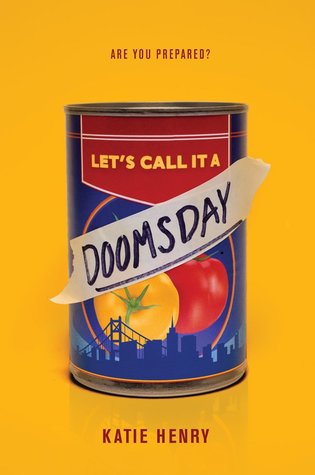
Let’s Call It a Doomsday- Katie Henry

I’ve loved Katie Henry ever since I read Heretics Anonymous last year, so I was super excited to read Let’s Call It a Doomsday (Katherine Tegen Books, 2019)- as soon as I learned of its existence, it went straight onto my TBR, despite the fact that its pub date was months in the future. I’ve been looking for it at the library for ages, but it had always been checked out (which is good! I never mind waiting; I’m happy that other people are enjoying the books I too want to read, and I always have a list of books I want to read that unfurls, rolls out the door, and heads for the Pacific Ocean, so, you know. No hurry). But this time, BINGO. It was in, and into my stack it went.

Ellis Kimball is obsessed with the end of the world. Nuclear disaster, earthquake, massive snowstorm, fires that wipe everything out, plague, she knows them all and she’s prepared for each scenario, keeping go-bags stashed at home, in her backpack, and in her locker. But her obsession is affecting every part of her life, including her family, and it’s after a session with her new therapist that Ellis meets the mysterious Hannah, who claims to have been having visions of the end of the world- visions that involve Ellis.

Buoyed by her acceptance into Hannah’s friend group, Ellis helps Hannah search for a young man she refers to as Prophet Dan, all the while preparing for the massive snowstorm that Hannah claims will bring the end of the world as we know it. But things get a little more complicated when Prophet Dan’s identity is revealed, and Ellis’s need to inform the world of its impending doom becomes urgent. Desperate times call for desperate measures, but faith, new friends, and the family who has been there for her all along might just be the answer to avoiding certain doom.

There’s so much to love about this book. Katie Henry obviously knows well what it’s like to live with anxiety (if not personally, than through excellent research and a deep sense of empathy), because there were quite a few times I was reading along and stopped to chuckle because Ellis sounded so much like what my brain does when I don’t stomp it back down. Her fears aren’t necessarily mine, but the thought processes are so similar, along with the constant negative self-talk, that I understood her well- though there are times when she and her mother, who is frustrated by a daughter she doesn’t understand and doesn’t know how to help, get into it, and Ellis eventually handles it in a more understanding and mature way than I would have. If your anxiety does center around disaster scenarios or the end of the world, however, Let’s Call It a Doomsday might either help or set off your anxiety, so please be careful.

I loved that Ellis’s faith and religious life- she and her family are active members of the LDS church- is woven into every aspect of the story. Family Home Evening is discussed multiple times, her family’s lax (so she feels) attitude towards food storage plays into her fears, multiple scenes are set before, during, and after church services, and how her religion may add to and help her anxiety is a huge theme throughout the novel. It’s not too often that you read stories where a character’s religion just is, without the novel having any ulterior motive, so I really appreciated this look at a religious teenager doing her best to live out her faith because of and in spite of her mental health challenges.

Hannah’s friends are great people; they’re smart, helpful, kind guys who protect the members of their group well, and this is demonstrated in multiple scenes, starting off when Ellis is warned in the beginning about Hannah having been through a hard time recently, and later on when Ellis overhears one of the boys trying to get Hannah to back off of something she and Ellis are doing that’s affecting Ellis negatively. The scenes with the guys were some of my favorites simply for eliciting such warm fuzzy feelings of friendship and trust. Tal, especially (who made me realized that the singer Tal Bachman’s first name is actually Talmadge, which I’d never considered before!), elicits a lot of warm fuzzies. The book is worth the read alone because he’s such a great character. That said…

I didn’t care for Hannah at all. I figured out her schtick almost immediately, and while I felt for her, she seemed too manipulative and sneaky to care as much about her as I did everyone else. To me, it felt like she was using Ellis and taking advantage of her anxiety to further serve her own needs, and that left a terrible taste in my mouth. Had I been in charge of the story, I would have changed how their friendship stood at the end, but I also understand why Ms. Henry let it play out as it did, and that didn’t change my enjoyment of the book itself.

Let’s Call It a Doomsday is a great read, to be read with some caution if you struggle with anxiety, but overall, to be enjoyed for the story of growth and self-acceptance that it is. Since it was published in August, it fits the PopSugar 2020 Reading Challenge prompt for a book published during your birthday month, so I can check another one off that list!

Visit Katie Henry’s website here.

Follow her on Twitter here.

fiction

As A Driven Leaf- Milton Steinberg

I’ve been aware of this book for years. I think I even picked it up and paged through it when we lived in Nashville (the main library there is seriously awesome; if you’re ever in the area, stop in and take a walk around. The collection is pretty good- some slightly dated material, but still pretty phenomenal, and the building is gorgeous. There’s even a large outside courtyard with a huge fountain, a large stage for performances and talks, and a children’s puppet theater. It’s been almost six years since I was last there, so who knows what other updates have been made since then!), but for whatever reason, I chose not to read it at the time. But during our first week in my Introduction to Judaism class, the rabbi recommended it and I figured it was finally time to pick up As A Driven Leaf by Milton Steinberg (Behrman House Publishing, 1939). I’m always a little nervous reading older books, since I still have a little bit of holdover fear from being made to read things like The Scarlet Letter in high school (I still can’t stand Nathaniel Hawthorne), and I’ve had some not-so-great experiences with dry, dusty historical fiction, but that wasn’t at all what I found between the covers of this book.

Elisha ben Abuyah, the son of a lapsed Jew, is raised adhering more to Greek tradition in the years of Roman rule in Palestine, but when his father passes, his uncle insists he study the Law of his people. After becoming a rabbi and becoming part of the Sanhedrin, doubts about his faith begin to appear, and though he tries hard to hold on, his questions can’t be ignored. Willing to risk everything for solid answers, Elisha begins a journey of discovery, of finding irrefutable evidence of what the truth really is, but this search will have devastating effects on him, on history, and on the lives of everyone he knows and loves.

This is an incredible book, one I cannot recommend highly enough. Elisha ben Abuyah (an actual historical person, though this is a fictionalized account of his life, with much conjecture and imagining) is an engaging, thoughtful character, and the era in which he lives is vividly alive in Steinberg’s elaborate, yet not overdone, description. Elisha’s arc is tragic; his unhappy arranged marriage and his search to view faith solely through a lens of logic ends disastrously for nearly everyone, even those not immediately involved, and there are some seriously gruesome scenes in here (torture, Roman murder, and a lion-versus-gladiator fight scene that turned my stomach and had me wide-eyed while reading in public). Steinberg doesn’t shy away from the difficult realities of life under Roman rule, nor does he tone down the more hedonistic aspects of the society Elisha found himself in after his excommunication and abandoning Palestine for Antioch.

It’s difficult to elaborate how fascinating I found reading fiction set in this time period (I believe the only other book I’ve read set during Roman rule is The Bronze Bow by Elizabeth Speare George, also a fantastic read). I haven’t ventured too much into the world of historical fiction; it’s not that I dislike it, but I’ve encountered some that have been dry, and so much of it seems to be centered around World War II that As A Driven Leaf seems absolutely…modern…by comparison. A breath of fresh air in that genre, if you will, despite the book being eighty-one years old. It’s an era I haven’t literarily-traveled to that often, so I really enjoyed my journey back in time to admire Elisha’s intelligence and dedication while still wincing at his bullheaded perseverance despite the consequences. (And because of the book being set during this time, I’m counting it as my pick for the BookRiot 2020 Read Harder Challenge prompt to read a historical fiction novel not set in WWII. Finally, I’m on the scoreboard with this one!)

This isn’t an easy book to review, as there’s so much going on and Steinberg’s messages are so profound, but it’s a deeply enjoyable read, one that can be read on multiple levels. It’s a glimpse into the past, an inspiration, a warning, an encouragement to search and an injunction to be prepared for the consequences. It’s thought-provoking in a multitude of ways, no matter if you agree or not with Elisha’s final conclusions. As a Driven Leaf is beautifully written and will leave you intrigued and wanting more from this thoughtful author, or at least for the book to never end.

Milton Steinberg passed away in 1950. You can see his other books here on Goodreads.

Mini reviews

Four mini-reviews!

I generally don’t enjoy cramming a lot of book reviews into one post, but sometimes it’s necessary, or it’s the best option. And this time I’m not even doing it as a catch-up, even though I’m a little behind. I’ve been doing some extra reading for my Introduction to Judaism class, cramming in some Jewish fiction and non-fiction around the edges of the reading I need to do for class (which varies by amount per week, but there’s extra suggested reading, and you know I read all those articles too!), just to expand my knowledge base because I find it helpful and also because I just want to know everything about everything in the world- totally an attainable goal.

ANYHOODLE. Here are a few of the extras I’ve read the past few weeks!

The Best of Sholom Aleichem by Sholom Aleichem, edited by Irving Howe and Ruth R. Wisse. Sholom Aleichem is best known for his short stories about Tevye the dairyman, which were gathered and shaped into the musical Fiddler on the Roof (which I haven’t seen, but there’s a version of it available with Amazon Prime, so I’ll get to it one of these days!). His short stories, translated from the original Yiddish, give readers a glimpse into life in nineteenth-century Eastern European shtetls. There’s laughter, joy, family, poverty, hunger, fear… The wolf is always at the door, but why not enjoy yourselves while you can? His writing is so very slice-of-life; the telling of the story is more important than a distinct conclusion. I worried that would bother me, but surprisingly, it didn’t; Aleichem’s method of storytelling is more than enough to carry each selection in the book. I’m jealous of those who can read him in the original Yiddish, because from what I’ve read, the language is so very nuanced that any translation loses a lot. I’m counting this as a pick for The Modern Mrs. Darcy 2020 Reading Challenge prompt of a book in translation.

Hereville: How Mirka Got Her Sword by Barry Deutsch. “Yet another troll-fighting 11-year-old Orthodox Jewish girl,” the story’s byline yawns, but this graphic novel is anything but tired. Mirka, who dreams of fighting dragons, struggles to learn the feminine skills her stepmother wants her to, and keeps finding herself in odd situations- lassoing a homework-eating talking pig with a serious attitude problem, for example. And those feminine skills come in handy when she meets a troll, of all things. This book is creative and fun and deeply imaginative, and I’m going to have to keep my eyes peeled for the other books in the series at my library (looks like they’re checked out right now! I’m glad; they deserve to be popular!).

The Three Escapes of Hannah Arendt by Ken Krimstein. Hannah Arendt is a name that keeps coming up over and over again in my reading, so I picked up this graphic novel biography that covers a short period of her life. She was brilliant and complex and Krimstein presents some tough material in an easier-to-digest format. Two quotes in particular stuck out to me:

“As fire lives on oxygen, the oxygen of totalitarianism is untruth. Before totalitarian leaders can fit reality to their lies, their message is an unrelenting contempt for facts. They live by the belief that fact depends entirely on the power of the man who makes it up.”

“The sad truth is that most evil is done by people who never make up their minds to be good or evil.”

I definitely want to read more about Hannah Arendt, but this feels like a good introduction.

The last 20-30 minutes of each Sunday night class is dedicated to learning the Hebrew alphabet, and I’ve never met a class I didn’t feel the need to go full on Hermione Granger in, so thanks to an extra-long interlibrary loan, I was able to work my way through Aleph Isn’t Tough: An Introduction to Hebrew for Adults by Linda Motzkin and Hara Person. This is the first language I’ve ever studied that doesn’t use the Roman alphabet, so it was intimidating to begin, but this book is incredibly thorough, introducing only a few letters and vowels per chapter so that the learner isn’t overwhelmed. Right away, the authors have you reading and writing words, matching English sounds with their Hebrew equivalents, and listing words the reader (who is assumed to have at least a basic knowledge of Judaism) is probably familiar with (and I was!). I was able to sound out (and recognize!) some of the Hebrew words when the class went down and sat in the sanctuary the other night, both around the room and in the prayer book. If you’re looking for the best, most basic place to start learning the Hebrew alphabet, Aleph Isn’t Tough should definitely be your first stop.

And with that, I’m only two reviews behind! Graphic novels and short stories aren’t always the easiest for me to review (and then there’s the language book!), so I’m feeling okay about covering these four books with one single post. I enjoyed all of these- for very different reasons- and would love to hear your thoughts if you’ve read any of them as well.

Happy reading, folks! 🙂

fiction

People of the Book- Geraldine Brooks

Phew! Last week was ridiculously busy, between life stuff, kid stuff, and the extra reading I have for the class I’m taking. I didn’t have a single chance to sit down and whip up any blog posts, even though I really wanted to! This week looks a little quieter, so hopefully I’ll be caught up in a few days…maybe. A few weeks ago, a lovely woman in the Facebook group for the podcast I’m currently listening to recommended People of the Book by Geraldine Brooks (Viking Books, 2008) to me. I’d heard of it but had never picked it up, and now seemed like just the time for such a book!

Hanna Heath has dedicated her life to preserving and restoring rare books, and she absolutely leaps at the chance to work with the famous centuries-old Sarajevo Haggadah, once thought to have been lost forever. Upon close examination, there are tiny clues- salt crystals, an insect wing, a single hair- as to where the Haggadah has been and who has owned it, sending the reader on a journey through the past to visit all the times and places it’s been. But the Haggadah’s story unearths a few hidden truths from Hanna’s life and illuminates a few paths before her that she never expected.

Bosnia, 1996. World War II Bosnia. Turn-of-the-century Vienna. Venice during the Inquisition. Barcelona during the time of the forced exile of the Jews, and Seville in the years before. People of the Book takes the reader on a journey through time, shedding light on not just the daily life of these times, but Jewish history, world history, allies and enemies, customs and mores. It’s not time travel- Hanna is never present as the reader is learning the details of the Haggadah’s past- but it has that same feel since Hanna’s restoration work and personal drama are interspersed with the Haggadah’s journey through time with each new clue she finds. I don’t know that I’ve ever read a book with so much information about rare document conservation before, and I found the descriptions of Hanna’s work with the book to be really fascinating. It’s obvious that a lot of research went into not only the descriptions of what Hanna was doing, but into the history behind the Haggadah, so my hat is off to Ms. Brooks for the intensity and scope of the work that went into the writing of this book.

History is often unkind in general and has been especially harsh to the Jewish people, so there are some content warnings for this book, including murder, death (including the death of children), rape, torture, slavery, and probably other things that I’m forgetting. There’s also a brief mention of a young adolescent being raised as a gender different from what was assigned to them at birth, as was occasionally the custom in their group at the time, but a mention of rape follows after this, so take care of yourself if these aren’t subjects you’re comfortable reading at this time.

People of the Book is an incredible read. It’s history that seems fresh, possibly because so much of what Ms. Brooks covers in the book hasn’t necessarily been overdone in fiction (or, if it has, I haven’t noticed!), and definitely because her writing style pulls the reader in so well, placing them directly in each period and surrounding them with the sights, the sounds, the smells, and the emotions prevalent in each era. The Haggadah’s travels bring the reader through so many different time periods that the reader is always kept wondering where it will turn up next, what excitement, what tragedy it will be witness to. I’m a little surprised I never picked this up before, but again, I think this book found me at exactly the time I needed it and was ready for it. I love when that happens. 🙂

Have you read any of Geraldine Brooks’s other books? I have a copy of Year of Wonders on my bookshelf right now; I’ll get to it eventually! People of the Book was my first book of hers, but I’m absolutely planning on reading more. I’ve kind of shied away from historical fiction in the past; I think I had a few bad experiences with the genre when I was young (looking at you, seventh-grade unit on Johnny Tremain) and that made me leery in general, but I need to move beyond that and cozy up to more of these great books by Geraldine Brooks and other authors, because reading this was an experience I want more of!

And, as luck would have it, People of the Book fits the 2020 PopSugar Reading Challenge prompt for a book with a map! There’s a lovely map in the book that details the travels of the Haggadah, so I’m happy to not only read a great book, but tick another box off on this challenge. 🙂

Visit Geraldine Brook’s website here.

Follow her on Twitter here.

nonfiction

The Blessing of a Skinned Knee: Using Jewish Teachings to Raise Self-Reliant Children- Wendy Mogel

I’ve mentioned before that I’m always trying to find resources to help me raise my daughter more effectively. Her personality is so very different from my son’s that I’m left scrambling 99% of the time, because I have very few tools in my box to deal with whatever she’s thrown at me. I’d heard of The Blessing of a Skinned Knee: Using Jewish Teachings to Raise Self-Reliant Children by Wendy Mogel, PhD (Penguin Books, 2001) before; she actually came through this area last year and I didn’t make it to see her (boy, am I kicking myself about that now!). But when this book showed up as one of the reading suggestions for my Intro to Judaism class, I knew it was time to see what wisdom it had to offer me.

Part Reform Judaism primer, part parenting how-to, Wendy Mogel gets at the heart of what kids need (and a little of what they want, and how the two work together). Today’s fast-paced world is tough on kids: they receive too much stuff (I don’t know a single parent who isn’t drowning in mass-produced kid stuff and constantly weeding things out), have too much input from all directions (school, family, friends, television, social media, music in the car and in stores), deal with ridiculous, age-inappropriate expectations, and get short-changed out of time with their stressed-out parents. The message they get is that in order to stand out from all of this is to behave in ways that get them the most attention, even if it’s negative attention. But Judaism has ways to teach families to slow down, unplug from the hustle and bustle around us, connect with each other, and celebrate the small, quiet moments when each opportunity presents itself.

Mogel writes about parental respect and how it’s okay and even necessary to demand it (this was HUGE for me. Like, HUGE), and how kids want to be part of the family and want to help out (and if they don’t, it’s still necessary for them to help without complaining). She discusses how to work with a kid’s nature and how to make the behavior that drives you the craziest work in your kid’s favor. She gives suggestions on how to get your kids to speak more respectfully and how to gently but firmly let them know they’ve been rude. It’s not necessarily to change a kid’s attitude toward something, she claims; change their actions first and after repetition, their attitude will follow. In Judaism, action counts more than attitude, and this applies to her parenting theories in so many different and fascinatingly effective ways.

Y’all.

You guys.

I’ve implemented quite a few things Ms. Mogel discussed in this book, with plans for more, and you would not BELIEVE the changes I’ve seen. (I’m kind of choking up as I type this.) I HAVE A NEW KID. For the past eight days, my child’s room has been clean (without me having to do it!!!) and all the toys she’s dragged to the living room have been picked up and put away, with minimal complaints, before bedtime. There’s been no backtalk, no sassing, no eye-rolling (!!!). She hasn’t argued with me about wearing shorts to school when it’s snowing. She puts her dishes in the dishwasher after asking if it’s clean or dirty, she asks to help do other chores and does some without being asked (not always effective; we had to have a conversation yesterday about why it’s not necessarily the best idea to line up the boots and other assorted winter footwear in the path between the kitchen counter and the refrigerator, but I thanked her for her enthusiasm and willingness to help and showed her a better place to line up the boots where no one would trip over them). And biggest of all?

We’ve. Had. No. Tantrums.

Like.

NONE.

This has never happened before. EVER.

I suggested that we implement a system where, each day, she earns part of an allowance (and it’s *not* a huge one) by keeping her room picked up, but her behavior is also tied to that allowance. Throwing fits, being unkind or disrespectful, not doing what’s expected of her, all that cancels out her allowance for the day. She has a calendar where she’s able to mark the day if she’s done everything she needs to. And every day, she’s so excited to mark off that she’s completed all her chores and behaved in a way that earns her something.

She’s still the same kid who gets a little too screechy indoors, the one who (of course) needs to pee the second I step into the shower and then spends my entire shower sitting on the toilet singing songs from Frozen, the kid who is slow to calm down when she’s excited and having a good time. But boy, does she snap right back into place when she gets her one warning (which is all she gets, and then the allowance is cancelled for the day), and she’s now constantly looking for ways to help out around the house.

It’s pretty wild.

I don’t know if it’s solely this book, or if she’s at the right place developmentally to finally begin responding to these kinds of measures, or maybe a combination of all that and something else, but this book has worked for us like nothing else has ever worked before. Ms. Mogel’s warning about parents who martyr themselves for their children’s sake serve no one, especially not their children, really spoke to me, and this past week, despite its business, has been the calmest, most productive, most well-behaved week of my daughter’s life, and I am deeply, deeply grateful for everything this book has taught me.

While there’s a chapter on implementing religious practice in your family’s life, you don’t need to be religious (or Jewish) to read and benefit from this book. You do need to be creative and able to apply Ms. Mogel’s lessons and ideals in a way that best fits your family. For example, you may not celebrate Shabbat weekly with a huge dinner, prayers, and songs, but maybe you can implement a weekly (or nightly, if your schedule allows for it) dinner and create your own rituals that carry weight and meaning for your family, that shape your life and give your kids something to look forward to and something they may carry on in their own families one day.

Even though I wish I’d read this earlier, I think this book came into my life at exactly the right time. I’ve got pages and pages of notes I’ll refer back to as necessary, and I’m looking forward to read Ms. Mogel’s The Blessing of a B Minus: Using Jewish Teachings to Raise Resiliant Teenagers when the time calls for it. I’m so grateful to Ms. Mogel for sharing her wisdom; it’s really changed things for our family, and I can’t speak highly enough about this book.

Visit Wendy Mogel’s website here.

Follow her on Twitter here.