nonfiction

Salaam, Love: American Muslim Men on Love, Sex, and Intimacy- edited by Ayesha Mattu and Nura Maznavi

While I’m not much of a series reader, after having read Love, InshAllah: The Secret Love Lives of American Muslim Women, as soon as I found out there was a companion version from the men’s perspective, I knew I had to read it, too. Fortunately for me, my library also had a copy of Salaam, Love: American Muslim Men on Love, Sex, and Intimacy, edited by Ayesha Mattu and Nura Maznavi (Beacon Press, 2014), so I happily grabbed it on my next library trip. (Which is pretty much every day, hence the name of this blog. Odds are, if I’m not at the library, I was there earlier in the day or will be there later on. Today, I was there twice. Why yes, I have no life!)

Just like Love, InshAllah, Salaam, Love is a collection of essays, this time written by American Muslim men on their perspectives on the search for love, dating, Muslim courtship, sex, the difficulties and joys of marriage, and all the happiness and heartbreak that come about in the search to find and live with a partner. Once again, this book highlights a unique perspective in romance; Muslim men aren’t necessarily the go-to voice when it comes to affairs of the heart, so each essay feels fresh, a novel (though it shouldn’t be) but welcome change from the usual, everyday take on love.

The essays, just as in Love, InshAllah, run the gamut on experiences: there are straight men who date, gay men who hide their relationships from their families (and one who grows in his faith after an encounter with a particularly devout man, which I found both charming and heartwarming), converts, Muslims from birth, men who submit to their parents’ wishes for a traditional Muslim courtship, men whose search for love continues, men whose loves died (both metaphorically and literally), love that works out, and love that doesn’t. Interspersed with it all are struggles with faith, culture (often the straddling of two or more cultures), and how to incorporate both fully into a relationship that may have ties to neither.

It’s possible I may have enjoyed Salaam, Love even more than Love, InshAllah (and I really enjoyed that!). I don’t read men’s writing as often as I read women- not on purpose, I tend to enjoy female writers more, especially when it comes to fiction- but reading about men’s thoughts on love and emotion and the struggle that goes with each, THAT was absolutely a breath of fresh air. How often do we hear about men’s feelings on anything? Men in our society- in most societies, sadly- are taught to not feel things, hide whatever they do feel, and never, ever discuss it, especially not in public. Hearing these men talk about having their hearts broken, about crying after being dumped by a girlfriend or the fear they felt over a loved one’s frightening medical diagnosis was a balm to my soul. (Are you listening, men? MORE OF THIS, PLEASE.)

The authors vary by background: many have ancestral roots in Africa, the Middle East, or south Asia (and many of these authors are first generation Americans); others are white converts who grew up Christian or Jewish and found a home in Islam, but often struggled to find a spouse. Several are bi- or multi-racial. It’s a beautiful mixture of people and places, and their stories had me wishing for more when I turned the final page.

I can’t recommend these books enough, and if you read one, you definitely need to read the other. I’m so glad to have a better understanding on some of the many Muslim American perspectives on relationships.

Reading these two companion books reminded me how much I enjoy essay collections, whether by a single author or multiple authors like these. If you have a favorite collection of essays, I’d love to hear about it!

(In writing this out, I discovered a few typos on my post of Love, InshAllah, namely, my failure to capitalize the A, and a misspelling of Nura Maznavi’s last name. I apologize greatly for these errors and have corrected them.)

Follow Love InshAllah on Twitter.

Nura Maznavi’s tweets are protected (and given the climate on Twitter some/most days, I can’t blame her).

Follow Ayesha Mattu.

YA

The Love & Lies of Rukhsana Ali- Sabina Khan

I’m not sure the route by which this ended up on my TBR. Was it from a Book Riot article on Muslim authors? Due to a fellow book blogger’s review? Could go either way on this, but I knew that I wanted to read The Love & Lies of Rukhsana Ali by Sabina Khan (Scholastic Press, 2019) almost immediately; the premise of the story ticked so many of my ‘THIS IS FASCINATING; MUST READ’ boxes.

I love when that happens. What didn’t happen was this being at the library the first two or three times I looked for it, which is both frustrating (for me!) and wonderful, because it means other people are reading it. Hurray for you, other local people! You have awesome taste in books.

Rukhsana Ali is seventeen, Muslim, Bengali-American…and a lesbian. Having a secret girlfriend isn’t something she can share with her uber-conservative parents, so she sneaks around, sneaks out, hides who she really is, nods and smiles and grits her teeth when her mother talks about Rukhsana getting married (seriously, Mom! College first, especially now that Rukhsana has a full ride to Cal Tech!). Her stress levels aren’t helped by her friends, who don’t get how uptight her parents are and how difficult it is to hide such a huge part of herself. Even Ariana, her girlfriend, doesn’t quite get it.

But all good schemes must come to an end, and when Rukhsana’s parents learn of Ariana, they hustle her off to Bangladesh (no matter that it’s near the end of senior year. Exams, what???), supposedly to visit her ailing grandmother, but the longer they’re there, Rukhsana begins to suspect their motives weren’t quite honest. And when arranged marriage becomes very real and very immediate, Rukhsana will have to dig deep, find all the strength she’s gathered from reading her grandmother’s diary, and fight for who she loves and who she truly is.

Remember that scene from Indiana Jones and the Temple of Doom, where the dude thrusts his fist into another man’s chest and rips out his beating heart? Reading this will make you feel like the second guy, your heart torn from your chest and paraded around by the author for everyone to see. At times, Rukhsana’s options are so limited and her parents, especially her mother, so dictatorial and insensitive, I felt claustrophic about her situation and her future. Her friends are both wonderful and frustrating, in that they don’t fully listen to her concerns and don’t try to understand the difficulties her cultural ties present in coming out; her relationship with Ariana is a typical teenage romance, in that they’re obviously in love but still learning how to communicate and navigate more mature emotional territory. Sweet, but also occasionally frustrating for both Rukhsana and the reader.

But Rukhsana’s parents. Hooooooo boy. Her father doesn’t get as much air time as her mother; Mom is…an uncomfortable-to-read character for the majority of the book. She’s the main source of homophobia and bigotry, and some of the things she says to her daughter and the ways she tries to remedy Rukhsana’s homosexuality are horrifying. Her grandmother, however, is an absolute gem; everyone should have a grandmother who loves them so unconditionally.

Content warnings: there’s a lot of homophobia and anti-gay slurs in the book; a character is murdered because he’s gay; there’s a diary entry that details marital rape and spousal abuse, and a later one that, quite chillingly and almost unexpectedly, includes child molestation (if not child rape; it’s not specified). Ms. Khan’s style is light, which helps the book stay away from Dementor-style darkness, but it’s still not a fun or safe-feeling read.

There’s a massive turnaround that I don’t want to spoil; some readers have complained that it felt a bit whiplashy and unrealistic. I totally understand that, and I also get how said turnaround could have happened, when the characters who experienced it were confronted with the consequences of the exact same attitudes that they had. It’s understandable, and personally, while I wouldn’t have been quite as forgiving as Rukhsana was, at least not so quickly, it did make for a pleasant ending.

The Love & Lies of Rukhsana Ali is a gut-punch of a YA novel, and was definitely worth the wait. I hope the other library patrons who checked it out before me enjoyed it as much as I did.

Visit Sabina Khan’s website here.

Follow her on Twitter here.

fiction · science fiction · time travel

Kindred- Octavia Butler

I’d heard of Kindred by Octavia Butler (Beacon Press, 1979) before; it was the first science fiction novel written (or published, maybe) by a black woman, which is huge. Since I’ve never really been a big sci-fi fan, I never really considered reading it until Anne Bogel recommended it on an episode of What Should I Read Next. As soon as she started to describe the plot, I sat up out of bed in the dark, looked Kindred up on Goodreads, and hit that Want-to-Read button. I. Was. In.

Dana, a black woman, has barely moved into the new house with her white husband when she finds herself thrown back in time to antebellum Maryland, just in time to save a young boy from drowning. The act of doing so nearly gets her killed by the boy’s parents and she returns to her own time with seconds to spare. She’s barely back before it happens again: she’s thrown back to the past to save this boy’s life again, and she comes to realize she’s there to keep him alive, distasteful as he and his slave-owning family can be, long enough to father the child who will become her great-grandmother.

The biggest challenge is, of course, learning to live as a slave. The literal backbreaking work, having no power or control over one’s life, the whippings, the constant disparagement, watching families split apart when someone is sold, it’s almost more than Dana can bear, but she just has to hold on until this despicable boy can become her great-great-grandfather…

What a mesmerizing book. During one of the trips, Dana’s modern day husband, Kevin, is dragged back with her. He poses as her owner, and there are unforeseen consequences that I won’t spoil that really make this novel shine. The descriptions are, on occasion, stomach-turning, and they should be; slavery was a horrible stain in American history and its consequences live on today, so Kindred and books that depict these horrors definitely need to be more widely read. I’m sorry that it took me this long to get to it.

Ms. Butler does a fantastic job at portraying Rufus, the boy who grows up become Dana’s great-great-grandfather, as both a decent human being and a hideous monster. I didn’t quite understand how Dana was able to keep herself from fully hating him, after seeing all the pain he and his terrible father inflicted on the slaves; I’m not sure I could do that, and maybe I’m all the worse for not being that kind of person, I’m not sure. Maybe it was what Dana did in order to survive her time in the past. Either way, though Dana tried her best to influence Rufus to be a better person, both for her sake and for the sake of the slaves on the plantation, for whatever reason, it didn’t take, and his behavior, along with that of his father, is often monstrous.

There’s a lot going on in this book. Race relations, class, women’s issues, politics, I think I could reread this and still miss quite a bit, because it’s an absolute tapestry of complexity. This is one of those books that I feel like almost anything I say will result in a massive spoiler; if history intrigues you, this is your book. Don’t let the sci-fi label fool you. There are no aliens, no space ships, no dystopian societies with robot overlords. This is time travel, pure and simple and terrifying, and it makes for a powerful novel that everyone should read.

Octavia Butler passed away in 2006.

Visit her website here.

romance · YA

I Believe in a Thing Called Love- Maurene Goo

I still love YA.

I don’t know if that will ever really change. I don’t read it quite as much as I used to, but the genre itself still calls to me. Books about the time in your life where so many roads are open, where possibility reigns and the future isn’t necessarily set it stone, what’s not to love about that? To be sure, there are a lot of YA novels that deal with extremely heavy topics- heaven knows being a teenager hasn’t ever been simple or easy, in any era- but a good light YA is a nice counter to some of the heavier nonfiction I read. The premise of I Believe in a Thing Called Love by Maurene Goo (Farrar, Straus, and Giroux, 2017) sounded adorable and exactly the kind of lighthearted YA romance I enjoy, which is how it ended up on my TBR list.

Desi Lee, first generation Korean American teenager and superstudent extraordinaire, is a mess around guys. Get her in front of one she finds cute and something terrible is bound to happen within minutes, which is why she’s never had a boyfriend. Enter Luca, the hot new artsy guy at school. Despite accidentally showing him her underwear close to immediately after their first meeting, Desi actually feels like this might work out with Luca, but just like she does for everything else in life, she needs a plan, something with concrete steps to check off so that she doesn’t screw this up. Thus Desi creates her list to achieve true love, based on the steps she’s gleaned from the K-dramas she watches with her widowed father.

But of course, while some of the steps go smoothly, life isn’t a scripted K-drama, and eventually Desi’s carefully-made plans go awry. Making things right is never easy, but even when she has to make things right, there’s a K-drama to help show her how.

There’s a lot to enjoy in this novel. While Desi’s a bit Type A and kind of a basket case from time to time, she’s also driven and goal oriented, which is admirable. Her attempts to connect with her widowed father are beyond sweet (is there a ‘dead mother trope’ trend in YA right now, or are all the dead mother books I’ve been reading lately just a coincidence? Starting to feel like I’m in a Disney movie, minus the helpful singing/housecleaning animals…), and I really, really enjoyed the peek into Korean American immigrant/first generation culture (it’s kind of funny; my husband came to the US with his family from Belgium when he was three; he grew up with one foot in both cultures, and it’s only obvious sometimes, usually in regards to things like cultural trivia, that he wasn’t born here and was raised by immigrant parents, which makes my daughter a first generation American on that side. Kind of neat to be able to wonder what her feelings will be on that and what parts of her experience will mirror Desi’s). I have friends who love K-dramas; I’ve never seen one, but this book really made me want to check some out! Ms. Goo includes a list of the K-dramas she loves in the back of the book, which is awesome and helpful.

What didn’t work for me were a few of the things on Desi’s list. ‘Making a list of the things I need to do to snag this hot guy/girl’ isn’t a unique trope, which doesn’t bother me, but Desi takes things way too far, at one point intentionally causing a car accident in order to further her plan to get Luca as her boyfriend, and that felt entirely unrealistic to me (and I’m not one to think that YA characters have to be exemplary in their behavior, but HOLY CRAP, WHAT A TERRIBLE IDEA, and no one makes as big of a deal about this as I think it warranted). Desi’s ridiculously smart, which I know doesn’t necessarily mean mature or full of good decisions, but yikes. Yikes, yikes, yikes. By the end, she’s hurt a lot of people and thrown away her interview at Stanford for Luca- granted, it was to help him during what she thought would be a difficult time, and it all ended up working out anyway (this is YA romance, of course; HEA for life!), but taking that kind of gamble on a boy when you’re seventeen isn’t the greatest idea, and it felt a little icky to me that as dedicated as she was before, Desi went down that road the moment a boy showed up. She’s the kind of character that could benefit from a year or so with a therapist, working on her self-esteem and some techniques to relax in mixed-gender social situations; having a boyfriend isn’t going to change all the problems that caused her to think she needed to make such a list in the first place.

So I liked this, but didn’t quite love it. I think I have another novel by Maurene Goo on my TBR, and as I did enjoy her writing style, I’m definitely hopeful that I’ll fall head over heels with her other books. 🙂

Do you watch K-dramas? Have you ever? Have you ever intentionally caused a car accident in order to make someone fall in love with you, and did you complete your court-ordered therapy afterwards (because that’s the only real outcome I can imagine for such a situation)?

Visit Maurene Goo’s website here.

Follow her on Twitter here.

fiction · YA

Internment- Samira Ahmed

Sometimes a book comes along that fits eerily well into the current cultural and political environment of the times. Internment by Samira Ahmed (Atom, 2019) is one of those books.

First off, content warnings. Internment focuses on racial and religious discrimination, and there are multiple instances of racial and religious hatred, including insults. There are also multiple scenes of violence and several deaths. It’s not hard to deduce that this book draws heavily from the current political climate, so be sure that this book, with its heaviness and reality-based horrors, is something you can handle at the time. It’s not an easy read.

Internment begins in a time when the United States government has begun placing heavy restrictions on the activities of Muslims, from where they work to how late they can stay out (history students, does this sound at all familiar?). Teenager Layla Amin is bristling under the unfairness of it all, but her parents are trying to stay optimistic. All their optimism crashes to the ground, however, when the authorities show up at their house one night to take them away to a Muslim concentration camp in the middle of the desert, run by guards who (for the most part) lack any shred of humanity, with other Muslims charged with keeping them in line (if you’re familiar with the term ‘kapo,’ this would be an example of it). Torn away from everything familiar, Layla can hardly believe that her once-comfortable life in the Land of the Free has been reduced to…this.

Almost immediately and often without thinking through the potential consequences, Layla begins making plans for freedom, enlisting other teenagers she befriends, as well as a sympathetic guard, who helps her contact her non-Muslim boyfriend back home. Slowly, Layla and her friends begin to enact changes around the camp, but the blowback and the repercussions are serious and deadly. The culmination of it all will leave you at the edge of your seat, frantically flipping pages and praying for resolution for Layla and all others forced into this kind of captivity.

I’m not going to sugarcoat it: given the current political climate and with daily stories about the horrors of migrants, asylum seekers, and others, including children, in camps with questionable-to-downright-horrific conditions, this isn’t an easy read and will break your heart several times over. Layla is a bit on the young side for her age, and while she’s obviously intelligent, she’s also reckless and doesn’t always think things through (although if she did, I’m not sure this story would have been so action-packed, so her more imprudent nature serves its purpose for the story). More in the interest of brevity, the story concludes much quicker than it would have in real life, wrapping up a bit more neatly than reason leads me to believe it would play out currently, and though the director of Layla’s camp veers slightly toward ‘caricature’ in his overt monstrosity and lack of self-control, Internment is still a chilling, way-too-close-to-reality novel that is worth the read.

In a world where we have camps where children are taking care of other small children, reading this had me rage-screaming in my head, but I don’t regret picking it up- quite the opposite, in fact. Internment will stick with me as I continue to struggle to find ways to voice my fury at the actions carried out by my country. Nothing ever feels like enough, but doing absolutely nothing isn’t acceptable to me: as Edmund Burke said, “The only thing necessary for the triumph of evil is for good men to do nothing.” Internment and the daily onslaught of news are both depressing reminders of that.

Visit Samira Ahmed’s website here.

Follow her on Twitter here.

nonfiction

Love, InshAllah: The Secret Love Lives of American Muslim Women- Nura Maznavi and Ayesha Mattu

There are some books I seriously look forward to reading the second they land on my TBR, and Love, InshAllah: The Secret Love Lives of American Muslim Women by Nura Maznavi and Ayesha Mattu (Soft Skull Press, 2012) was one of those books. I’ve always known that many Muslim marriages are made not through dating, but more of a process that involves both families. It’s not the case for all Muslims, though, and I was interested in learning more.

Love, InshAllah is a collection of essays written by American Muslim women about their search for love. Some of them go the traditional route: their parents find available young men they think are suitable for their daughters and the daughters are free to say yes or no at any point in the process. If, after a few meetings, the couple decides they’re compatible and that a marriage between them would be the best option, the family celebrates and begins planning a wedding. The book showcases instances both of where this worked out fabulously and where the marriage ended, sometimes quickly, in divorce (which, when you think about it, isn’t that different from the average American marriage. I’m guessing most of us know at least one couple who married and then divorced fairly soon after).

Other women date in a more typical American fashion; a few opt to become someone’s second wife, after putting a lot of thought into it and spending time with the first wife. For at least one of the wives, being a second wife offers her the independence and freedom that she felt being a sole wife wouldn’t, and her reasoning for this decision makes a lot of sense (still not something I would choose for myself, but I have to agree with her that the down/alone time would rock!). Some women never find what they’re looking for and the search continues, while others revel in their happily-ever-after.

Love, InshAllah is real-life romance and the search for it, viewed through a cultural lens that I think most Americans don’t spend much time thinking about. It’s a book that gives Muslims a chance to see themselves on the pages and that will help non-Muslims both understand and appreciate our differences. Something doesn’t have to match my path or my life choices in order for me to recognize its worth for someone else, and that alone made this book the perfect read for me.

There’s a section of author bios in the back, as is common with essay collections such as this, and I do wish that these books kept the bios at the end of each author’s piece, since it’s difficult for me to remember each author’s name once I get to the end, and I don’t necessarily want to be flipping back and forth through the whole book. Regardless, Love, InshAllah is a fascinating, insightful look at romance in a group of women who don’t often get the chance to tell their own romantic stories, and I’m so happy that this book exists and that the book was readily available to me through one of my local libraries.

The two authors/editors have also teamed up to produce Salaam, Love: American Muslim Men on Love, Sex and Intimacy, and you better bet I hit the WANT TO READ button on that baby immediately!!!

Follow Love InshAllah on Twitter.

Nura Maznavi’s tweets are protected (and given the climate on Twitter some/most days, I can’t blame her).

Follow Ayesha Mattu.

memoir

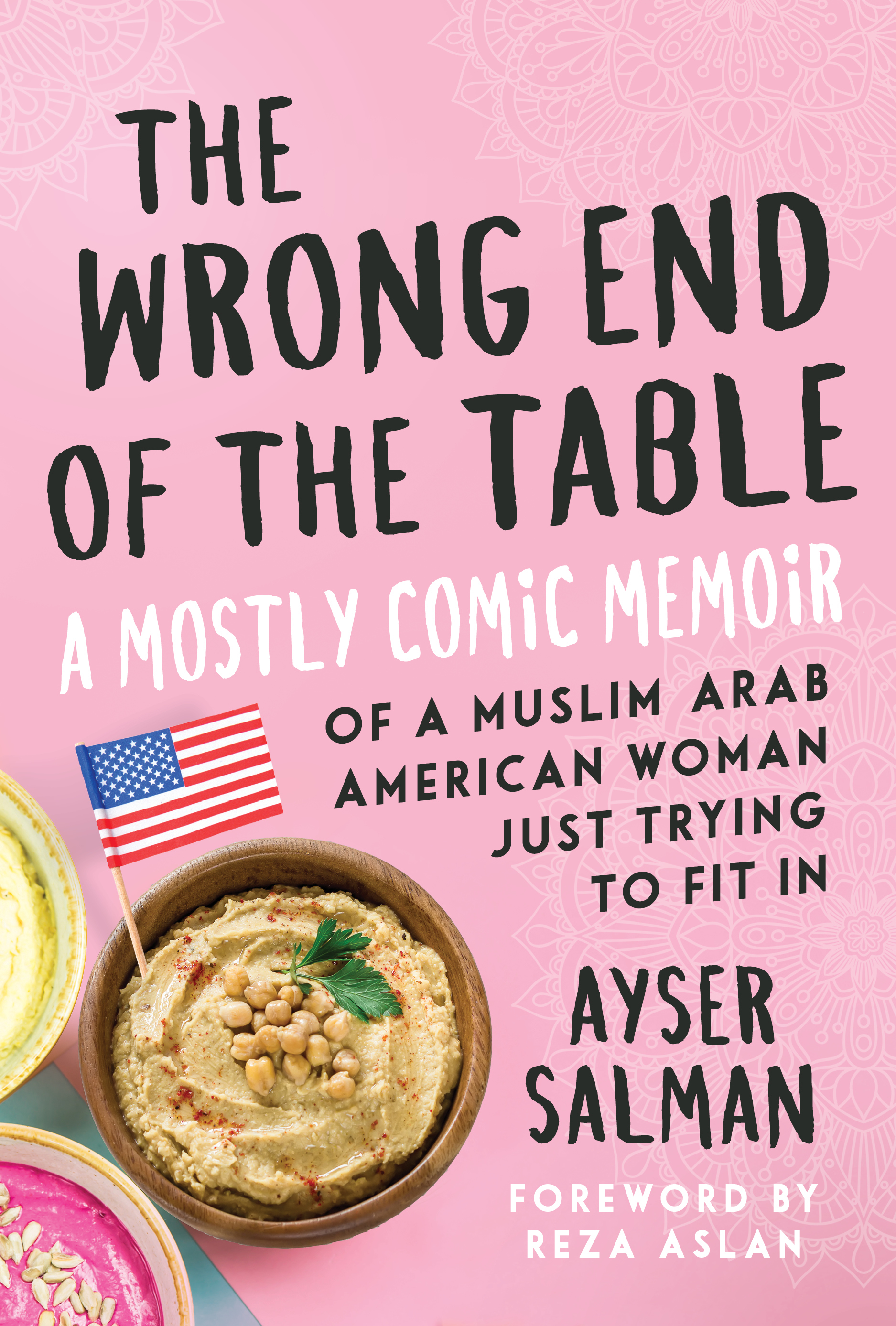
The Wrong End of the Table: A Mostly Comic Memoir of a Muslim Arab American Woman Just Trying to Fit in by Ayser Salman

Another book from my wandering-the-library-with-no-list day! The Wrong End of the Table: A Mostly Comic Memoir of a Muslim Arab American Woman Just Trying to Fit In by Ayser Salman called out to me right away from the New Arrivals shelf- with a title like that, how could it not? We’ve all felt like we’ve been sitting at the wrong end of the table at one time or another in our lives, as Ms. Salman points out; I’ve definitely been there (#socialanxiety #awkward #thisiswhyIstayhome), and so this jumped off the shelf and into my book pile. 🙂

Ayser Salman was born in Iraq.. Her family moved to the US when she was three for her parents’ jobs (as well as to flee the growing fascist regime), living first in Ohio and then moving to Lexington, Kentucky, which did have a small Arab community (very small, from the sounds of it). Ms. Salman never felt like she fit in with the other kids: the food she ate was different, her religion was different, her hair was different, her family’s customs were different, even her name was different from those of her fellow classmates. There’s no angst, no whining or woe-is-me style of writing here; on the contrary, Ms. Salman displays a level of humor and good-natured acceptance of her far-too-often outsider status in her youth that would be difficult for most to achieve. When her family spends a few years in Saudi Arabia, though some things ring familiar (she’s finally with people like her!), there are still plenty of times she remains on the edges.

Ms. Salman covers a variety of topics from her life, from her primary education, her love life (and occasional lack thereof, which isn’t always a bad thing!), her parents (you’ll love her mother) and her relationship with them, siblings, her work life and her struggle to get where she is, how September 11th affected her community, and much more. Over the course of these many essays, she grows from a child who can’t quite find the place where she’s supposed to fit in, into a woman who’s fully able to forge her own path, create her own place, and embrace all that her history and her culture mean to her.

The Wrong End of the Table is a fun read. Ms. Salman’s comical way of explaining her childhood antics had me smiling as I turned the pages, her relationship with her mother charmed me to pieces, and the family’s move to Saudi Arabia, coupled with her fear, fascinated me. I’d read accounts of adults moving there, but never that of someone who moved as a child, so this book was worth the read for that alone, to better understand what that experience is like.

She does get into politics a little, including the Muslim ban; I don’t think there’s any way for that particular subject to be avoided these days, nor should it, especially since it affects Ms. Salman’s community and most likely affects people she knows personally. Her tone is optimistic, more so than I would have been, and so I’m only mentioning this so that you keep it in mind when you’re choosing what you can handle reading. There’s an awful lot in the news that I’m currently not handling well at all; I’ve had to put a few books down because I’m not in the right headspace to be able to carry the emotional weight of those books as well as everything else right now. (And that’s not to say that I won’t ever go back to those books at a different time.)

So this was a great modern take on living in the US as a Muslim immigrant, by a woman with a gift for storytelling. I enjoyed reading such a refreshing take on American life through Ms. Salman’s eyes.

Visit Ayser Salman’s website here.

Follow her on Twitter here.

memoir

On the Outside Looking Indian: How My Second Childhood Changed My Life- Rupinder Gill

Last week, I ordered four books via interlibrary loan. Two of them came in; I’m still waiting for the other two, and so I ordered four more yesterday. I try to read mostly adult titles during my library’s Summer Reading program- in the past, the sheet has said that only adult titles count, not YA. It doesn’t say that this year, so I’m letting one or two slip in there, but I’m mainly trying to keep to the spirit of it all. That said, most of the books at my library left on my TBR are YA, and I haven’t had a chance to head to an out-of-town library, which means *cue ominous music* I was left to wander the stacks without a list of books.

GASP.

That’s not a bad thing, but sometimes I just wander and wander and get so overwhelmed by all the choices that I have no idea what to choose. And wandering the stacks was how I came upon On the Outside Looking Indian: How My Second Childhood Changed My Life by Rupinder Gill (Riverhead Books, 2011).

Rupinder’s parents were strict, so strict that she and her three sisters spent most of their childhood cleaning and watching TV, unable to leave their basement and participate in school activities or visit with friends. Dance lessons, field trips, class camping trips, piano lessons, sleepovers, all requests were denied for reasons both cultural and economic, leaving Rupinder and her sisters feeling alienated from their classmates for more than just being the only Indian faces in town. Turning 30, Rupinder begins to realize how few chances she had taken throughout her life, how small her life had become. Making a list of all the things she’d wanted to do during her childhood but hadn’t been able to, she sets forth to finally tackle some of those things.

Tap class. Swimming lessons. Getting a dog. A Disney vacation, a move to a big city, attending camp and a sleepover. Rupinder’s life slowly fills throughout the year, and she begins to bloom with newfound self-confidence and understanding of some of her parents’ past reasoning. It’s not perfect: swimming is scary, she comes to the conclusion that maybe her parents were right about getting a dog (no worries here, the majority of her dog experience comes from dogsitting her sister’s dog, not getting her own and then regretting it. Getting a pet is something she puts a lot of consideration into, moreso than most pet owners, I think!), and she takes a few leaps that will change everything, but it’s worth it. Reliving the childhood she never had forces Rupinder out of the box she’d become far too comfortable in.

This was fun! I really enjoyed reading about the Gill family dynamics and what their particular version of two immigrant Indian parents and a passel of Indian-by-heritage-but-more-culturally-Canadian children looked like. While I was allowed to visit friends’ houses and attend sleepovers when I was young, I wasn’t allowed to join softball or take karate, two things I very much wanted to do, so I could definitely relate to her frustration there. Her joy (and occasional discomfort) at learning new skills like tap dancing and swimming and the major leaps she took (the move, her job, emailing someone at Disney about free tickets) were a pleasure to read and made me wonder what I’m missing out on by not trying.

There were a few parts where this skipped around in time and threw me off, particularly a description of a trip to India with Ms. Gill’s mother, which left me flipping pages and wondering if this was taking place in the present or the past. There’s no major final conclusion to the end, no life-changing realization or calming sense of closure earned by finally being able to participate in such long-denied activities, but Ms. Gill seems satisfied by the path she’s started down, and it seems to have worked for her: throughout the course of the book, she decided that she wanted to leave her career as a television publicist and instead write for TV. As I was doing a Google search to find her online, I learned that she’s one of the writers for Schitt’s Creek, which I watched and very much enjoyed earlier this year. Well done, Ms. Gill!

While this wasn’t my favorite memoir of all time (and I think a lot of the Goodreads reviews are a little too harsh), it was relaxing reading, although at times wistful and occasionally saddening when it came to the racism Rupinder and her sisters experienced (seriously, people? CAN WE NOT ACT LIKE THAT???). I admire anyone who has such follow-through, and as Schitt’s Creek will end with its sixth season, I’m thinking we’ll see more awesome things from Rupinder Gill down the road.

What are some things you weren’t allowed to do when you were young? Have you ever considered doing them now??? (I have zero desire to play softball these days, and I’m not sure my back could handle any kind of martial arts, so I’m good there. The dream of one day attending Concordia Language Villages is still there, however…)

Follow Rupinder Gill on Twitter.

romance

Tikka Chance on Me- Suleikha Snyder

Is there any better feeling than the one you get when your phone signals an email, and you check it and it says, “Your library book has automatically been downloaded to your account”??? This is the second time this year that I’ve gasped, loudly, in sheer, unadulterated excitement due to one of those emails. I’d been on the waiting list for Tikka Chance on Me by Suleikha Snyder (published by Suleikha Snyder, 2018) for…probably over a month, although it was on my TBR list for longer than that. I never mind waiting for library books; it makes me happy that other people are reading and enjoying the book as well, but I was reeeeeeeeeeeeeeally looking forward to this. So when it showed up in my email, I had to squee more than a little!

Pinky Grover came home to work in her family’s middle-of-nowhere Indian restaurant when her mother got sick, but now that Mom is better, Pinky is…still there. She bides her time fantasizing bout bad boy Trucker Carrigan, head of the dangerous Eagles motorcycle gang, who comes in constantly to eat with his crew at the restaurant and make eyes at Pinky. On the surface, they’ve got nothing in common and both of them know they should stay away from the other, but the chemistry between them is incendiary. Trucker’s not quite what he seems, and after Pinky figures out his secret, she’s even more all-in, even though she knows the only destination for the two of them is heartbreak in the extreme. Trucker and Pinky ride it out (literally…) as far as their fledgling relationship can go, but when the time comes to say goodbye, how can either of them move on?

Whew, this is spicy and delicious! (Much like my favorite local Indian restaurant, which I haven’t been too in far too long and where I could eat every single day of my life. Indian food is my favorite of all the cuisines.) This is about as far away from a chaste romance as you can get, so choose something else if you prefer that genre. Pinky as a character is an absolute delight; she’s dutiful to her parents but still determined to be her own person and live her own life. Her goals are, for now, on hold, but she hasn’t abandoned them. Trucker (whose real name is Tyson), is an enigma with a surprisingly enchanting center, a not-*quite*-so-bad boy with a heart of steamy, molten-lava sexiness. They’re two people from two entirely different worlds, but Suleikha Snyder has crafted some scorching chemistry between the two of them, and Pinky and Trucker are instantly believable as a couple.

Ms. Snyder has absolutely gained another fan with Tikka Chance on Me. I’m so looking forward to reading more from her. Not only do I admire her writing, she’s so open and honest on Twitter about suffering from anxiety and depression. There have been a few conversations lately between different writers, talking about their struggles, and, as someone who has dealt with lifelong anxiety as well as bouts of major depression that started when I was thirteen (which went mostly ignored by my family, since it was 1993 and no one really knew what to do about such a problem where I lived at that time), seeing people discuss their issues so openly is still such a balm to my soul. I hate that Ms. Snyder has to deal with this, but I’m so, so grateful that she uses her voice to heighten awareness and make others, including me, feel not so alone. It really does help.

To sum it up, Tikka Chance on Me combines the sweet and the spicy in a way that will warm every last cell in your body, and leave you craving both more from the author as well as a plate or twenty of tikka masala (make mine tofu, please).

Visit Suleikha Snyder’s website here.

Follow her on Twitter here.

memoir · nonfiction

Muslim Girl: A Coming of Age Story- Amani Al-Khatahtbeh

During the month of Ramadan, BookRiot came out with a list of memoirs by Muslim women, and, always eager to learn more about the world and my neighbors (we have a good-sized Muslim community in my town and the surrounding towns), I pored over the list, adding several to my Goodreads TBR. Muslim Girl: A Coming of Age by Amani Al-Khatahtbeh (Simon Schuster, 2016) sounded interesting, and I was happy to find that my local library branch had in on the shelves (though not in stock; I had to return several times before it was available. As a reader, you’d think that that would be frustrating, but honestly, I’m not ever frustrated by that- I’m happy that my fellow townsfolk are reading, and they’re reading the same awesome books that I want to read! I live amongst great people, you guys).

Amani Al-Khatahtbeh is the founder of MuslimGirl.com, but before she began to change the internet and make its first real space for young Muslim women, she was a nine-year-old girl whose entire world changed the day the Twin Towers fell. Life for American Muslims altered dramatically that day; while Ms. Al-Khatahtbeh does recount a few positive experiences with kind people offering support, she and the members of her community were collectively assigned blame for horrors perpetrated a group of individuals who shared little more than their label. For a while, she and her family returned to Jordan, but ultimately came home to the United States, where she found she needed a deep sense of courage and self to even leave the house some days (and not without reason; a quick Google search is showing me multiple stories about Muslims, both men and women, pushed onto subway tracks and down subway stairs, while being called terrorists).

Ms. Al-Khatahtbeh recounts the lack of self-confidence she had growing up, and how that began to change as she matured. Founding MuslimGirl.com, first on LiveJournal and then moving it to its own domain, changed her life and launched her as a public personality, able to speak out for young women who work incredibly hard to make places for themselves in a society who, far too often, view them only as a single story.

Muslim Girl is a slim tome, but it speaks volumes, and I’m grateful to Ms. Al-Khatahtbeh for sharing her story. Despite living in such a diverse community, my world is pretty small right now (home, driving kids and husband places, running errands, and that’s pretty much it). Now that my daughter will be going to school soon, I’m hoping to be able to become more involved in my community (although I’m not yet sure how; my terrible back limits my abilities), but until then, it’s important to me to read books written by people who have experienced the world differently than I have, and this book absolutely fits the bill. I’ve known that the Muslim community has suffered terrible treatment since September 11th; I’ve read the news stories and been horrified, but this is the first first-person account I’ve read of the discrimination they’ve endured. I’m saddened, I’m angered, I’m bewildered that so many people, instead of learning and understanding, lash out in ignorance. Why aren’t we better than that?

I always feel a little out of place reviewing books by marginalized authors. My job as a random white woman blogger who has read and enjoyed this book, I feel, is merely to amplify the existence of Muslim Girl. Don’t read my words; read Amani Al-Khatahtbeh’s. Hers are the important one here, hers and those of others that are routinely pushed to the side and ignored or shouted over; listen and work to understand to what she has to say, because it’s the only way we’re going to achieve a more compassionate and accepting society, where everyone can thrive.

Visit MuslimGirl.com here.

Follow Amani Al-Khatahbeh on Twitter here.